
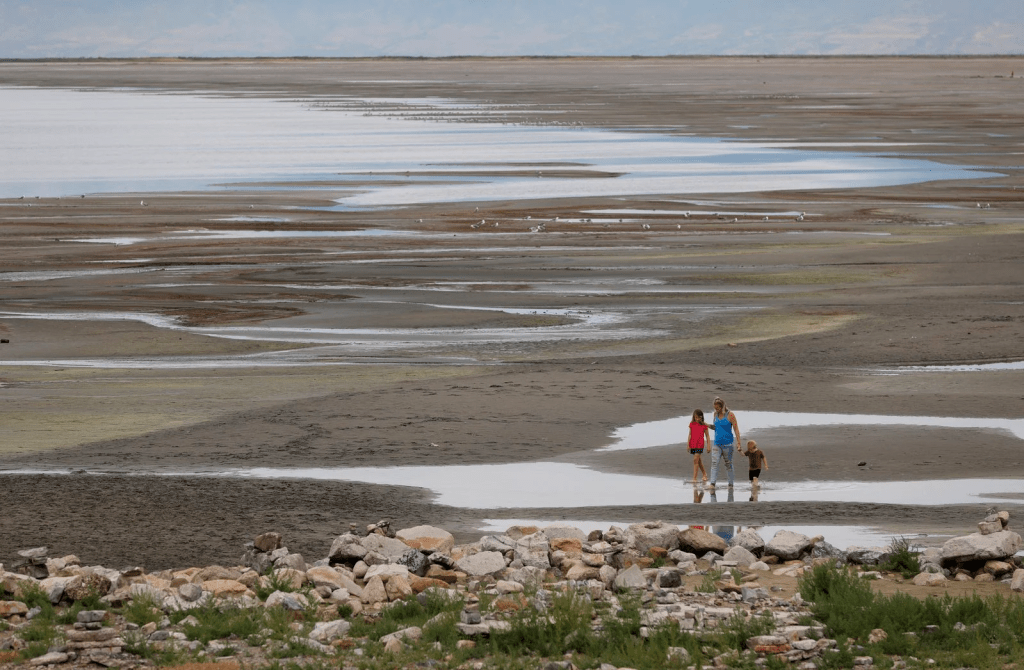
Recently, officials in Utah are scrambling to reverse the damage done to the Great Salt Lake. But what is causing the collapse of the lake, how can officials fix it, how much will it cost, and what are the impacts if the lake collapses?
First up, why is the Great Salt Lake on the edge? The answer is simple: too much salt, not enough water. Water levels in this lake, much like many other lakes and rivers in the western U.S., have declined with global warming and overuse. Specifically in the Great Salt Lake, the wildlife will not be able to survive much later, much as they have adapted to the salty conditions. As an example, brine flies, known for swarming on the lake by the billions, have been dying off. These are bugs that have adapted to the salty conditions as much as they can, but with the salinity level increasing as the freshwater is not there to dilute it to habitable conditions, the toll is evident. What is the problem with this, you may ask? Well, these flies are crucial to the food chain– they are a feast for the many birds that migrate to the lake every year.
Next up, how can this decline be reversed (or set back)? Currently, the snowfall Utah is receiving is beneficial to the water levels, but after that, officials are planning to purchase water rights/leases to boost lake levels. The state also plans to, again, purchase water leases from agricultural- purposed land that will lead to the lake. With the considerable budget the state is putting towards this cause, the Great Salt Lake could be back in business!
To continue, how much is this all costing? The Utah governor stated in his budget that around $132 million dollars would be dedicated towards the lake. However, depending on the circumstances, more money could be allotted to save the Great Salt Lake.
Finally, what impacts will the collapse of the Great Salt Lake have on Utah in general? Well, environmentally, dust from the dried edges of the lake was found to contain metals (such as arsenic). This dust is blowing into residential areas in Salt Lake City and contaminating the air. This is a health hazard– which will discourage tourism and, ironically, contribute to urbanization as people crowd inwards. Next, a more obvious impact, brine shrimp are dying off, leading to a decline in Utah’s aquaculture.
Sources:
https://www.sltrib.com/news/environment/2022/11/08/great-salt-lakes-ecological/
https://greenly.earth/en-us/blog/ecology-news/what-is-the-problem-with-the-great-salt-lake-drying-up
https://wildlife.utah.gov/gslep/wildlife/brine-flies.html
https://www.sltrib.com/news/environment/2022/11/08/great-salt-lakes-ecological/
 Energy for the Environment
Leave a comment